Mining has always been one of the world’s most demanding industries. The worksite shifts constantly — trucks move around the clock, terrain changes by the hour, and the margin for error is razor thin. In an environment where every second counts, the ability to make fast, informed decisions isn’t just a competitive advantage. It’s survival.
That’s exactly why Digital Twin technology is gaining serious traction across the global mining sector.
What Is a Digital Twin, Really?
A Digital Twin is a live virtual replica of a real-world system, object, or process. Unlike a static 3D model, it actively mirrors what’s happening on the ground using real-time data and simulations. It tracks history, reflects current conditions, and helps operators monitor, analyze, and predict performance — all from a centralized command center.
In mining, this translates to something remarkable: full situational awareness across an entire operation, without setting foot on the site.
Turning Complexity Into Clarity
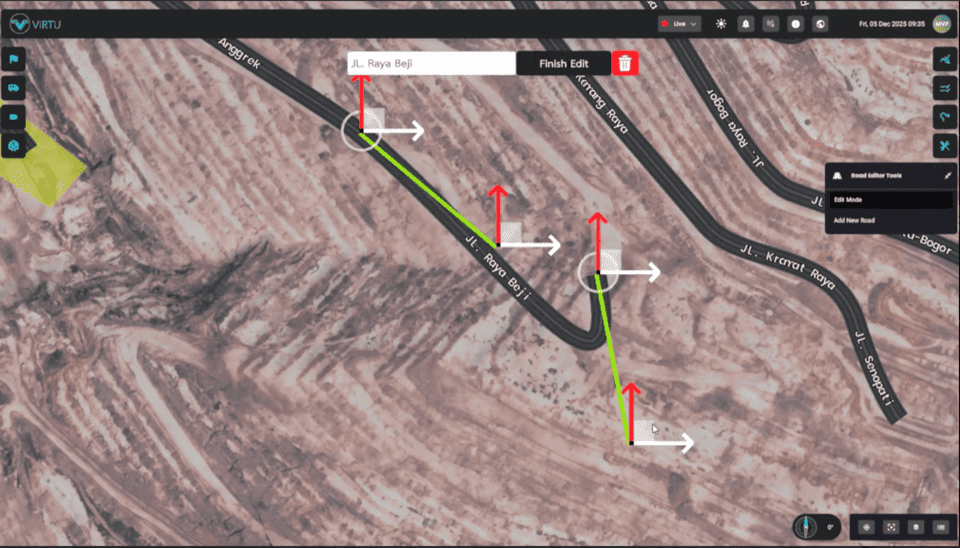
Picture a large open-pit mine. Dozens of haul trucks moving simultaneously, roads shifting as excavation progresses, safety zones changing by the shift. Managing this manually — or even through flat satellite imagery — leaves enormous gaps in understanding.
A Digital Twin changes the picture entirely. A 3D topographic view gives supervisors an intuitive, actionable overview of the entire site. Truck movement patterns become visible at a glance. Road speed data can be color-coded — green for safe, yellow for caution, red for danger — giving command teams instant awareness of where intervention is needed.
This isn’t just about convenience. It’s about unlocking a fundamentally better way to run operations.
The Numbers Speak for Themselves
Companies that have implemented Digital Twin solutions have reported significant results. According to research by Hexagon, teams saw a 49% increase in productivity and a 46% reduction in operational risks. PwC’s research on manufacturing applications found a 50% reduction in unplanned outages — a critical metric in mining where equipment downtime has a direct, measurable impact on revenue.
Faster decisions. Fewer surprises. Lower costs.
Built for the Pace of Mining
What makes Digital Twin particularly powerful in mining is its ability to keep up with the industry’s pace. When the landscape is changing in real time, you need intelligence that updates in real time. Historical playback and auditing features allow teams to review what happened, when it happened, and why — making it easier to learn from incidents and prevent recurrence.
Predictive maintenance capabilities mean that equipment problems can be spotted before they cause costly shutdowns. Instead of reacting to failures, teams can plan ahead, schedule maintenance during low-impact windows, and keep operations running at peak efficiency.
The Competitive Edge That Mining Needs
The mining industry is mature and highly competitive. Margins are tight, regulations are strict, and the pressure to optimize never lets up. Digital Twin technology offers something that has historically been hard to achieve in mining: clarity in the middle of complexity.
For companies ready to move beyond guesswork and gut feeling, this technology isn’t a luxury — it’s a strategic necessity.