For years, “mining simulator” meant one thing: a full-motion cabin. A replica operator’s seat mounted on a hydraulic platform, wrapped in curved screens, that pitches and rolls to mimic a haul truck climbing a ramp. They’re impressive machines, and they’re expensive ones. Lately a second option has crowded into the conversation — the VR headset simulator — and mining companies weighing a purchase are often unsure how the two actually compare. The honest answer is that they’re different tools solving overlapping problems, and the right choice depends on what a particular operation is trying to fix.
What the motion platform does well
A full-motion cabin’s strength is physical fidelity. When the platform tilts as a virtual truck crests a grade, the operator’s inner ear feels something close to the real sensation. For training the bodily, seat-of-the-pants feel of operating heavy equipment, that physical motion is genuinely valuable, and nothing in a static headset fully replaces it.
The trade-offs are equally real. A motion-platform simulator is large, heavy, and effectively immovable — it lives in one room, and operators come to it. It’s costly to buy and to maintain. And each unit typically trains one operator on one equipment type at a time, which makes scaling across a workforce slow and expensive. For a large mine with hundreds of operators spread across remote sites, that footprint is a serious constraint.
What the VR headset does well
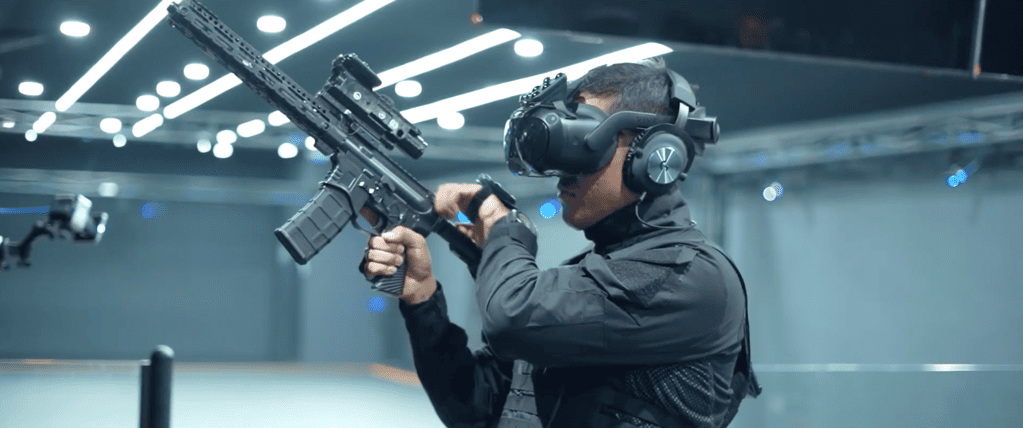
A VR simulator inverts most of those constraints. The hardware is portable — a headset and controllers that travel to site in a case, rather than a room operators must travel to. It’s a fraction of the cost per training station, which means an operation can run many operators in parallel instead of queuing them for one cabin. And a single VR setup can switch between equipment types and scenarios in software — excavator one session, haul truck the next, a hazard drill after that — without any change of hardware.
This is the model Indonesian developer Virtu has built its mining training around: a portable VR-based mining simulator that reconstructs cabins, controls, components, and work procedures, and records each session as tracked data. The pitch isn’t that it reproduces the physical jolt of a motion platform — it’s that it makes high-volume, scenario-varied, data-tracked training affordable enough to run across an entire workforce, including at remote sites a motion cabin would never reach.
The honest comparison
Neither format is simply “better.” A motion platform wins on raw physical sensation and is the stronger choice where the bodily feel of operation is the specific thing being trained, and budget and footprint aren’t constraints. A VR headset wins on cost, portability, scalability, scenario variety, and data — which matters most when the goal is to train many operators on many situations, safely, without halting production or buying real-equipment seat time.
A growing number of operations land on a blend: VR for the high-volume fundamentals, procedures, hazard recognition, and the long tail of scenarios, with limited motion-platform or live-equipment time reserved for the final physical polish. Used that way, the two aren’t rivals. The VR stage makes the expensive stage more productive, because operators arrive already fluent in the procedures.
How to actually decide
The practical question isn’t “which technology is best?” but “what is this operation’s bottleneck?” If the bottleneck is that operators lack the physical feel of the machine, lean toward motion. If the bottleneck is that training is too slow, too costly, too risky, or impossible to deliver to remote sites at scale — which is the more common complaint — VR is the tool built for that problem. Counting the per-operator cost, the number of people who need training, and whether the equipment has to travel to the workforce usually makes the answer clear long before any demo.
A mining industry simulator is only as useful as the bottleneck it removes. The first step is naming the bottleneck honestly — then the format chooses itself.