Most of a Military and Law Enforcement officer’s working hours aren’t spent shooting. Not even close to shooting situations. Studies from various countries have shown the same consistent pattern for years: use of force occurs in a small percentage of total contacts with civilians. Lethal force — even smaller still. Yet curiously, training programs across nearly every institution keep allocating disproportionate hours to firearms and tactical drills, while communication and de-escalation skills get the leftovers.
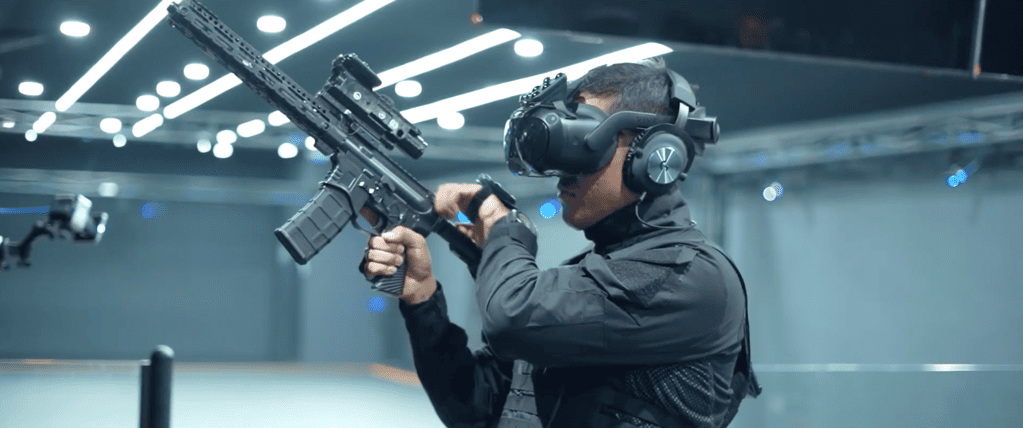
This imbalance has real consequences in the field. Officers end up sharp at tactical capabilities they almost never use, and underprepared for the communication situations that fill their everyday shifts. VR combat training platforms — yes, even with “combat” in the name — can also support de-escalation and crisis communication training. Here’s what that actually looks like.
Why De-escalation Training Is Hard to Do Well
De-escalation skill development runs into several real walls in conventional training.
Role-playing with fellow trainees rarely produces realistic conditions. The role-player knows it’s just a drill. Real emotional distress, real mental health symptoms, real intoxication — none of it can be faked convincingly by a colleague. What trainees actually learn is how to handle a colleague playing a difficult person. Not how to handle an actual person in crisis.
Professional actors can get closer to realism, but the cost climbs fast. Actors who can credibly portray specific mental health presentations or crisis states aren’t easy to find. Their fees aren’t small either. And this cost is what limits how often training can be repeated, which in turn limits how deeply the skill develops.
Case studies and video reviews deliver cognitive learning, not practice. Officers can understand de-escalation principles intellectually and still have no practical ability to apply them when the pressure hits.
Field experience is the most effective teacher and the most ethically problematic one. Learning de-escalation on the job means every learning event is a real incident with real consequences for civilians.
This combination of constraints is exactly why de-escalation skill development has been an unevenly grown area in tactical training, despite everyone agreeing the skill matters.
What VR Can Realistically Provide
VR de-escalation training brings several capabilities to the table that conventional methods can’t match.
NPCs can present consistent crisis behaviors across multiple training sessions. A character built to portray a psychotic episode will present the same way to different trainees — making standardized assessment of trainee response actually possible. Even skilled actors struggle to hold that consistency across many sessions.
Behavior can be programmed to respond to what the trainee actually does. Calm vocal tone plus active listening techniques? The NPC can be configured to gradually de-escalate. Commanding or confrontational language? The NPC escalates instead. This feedback loop creates direct learning about which communication approaches really work.
Scenarios involving vulnerable populations — people in mental health crisis, trauma victims, distressed children — can all be drilled without putting real humans through repeated re-enactment of difficult experiences. That’s an ethical advantage conventional training simply cannot match for these specific contexts.
Repetition is essentially unlimited. NPCs don’t tire. They don’t experience emotional fatigue. They don’t need breaks. Trainees can run the same scenario many times to build real fluency.
Categories of De-escalation Scenarios
Several scenario categories show up regularly across VR de-escalation training programs.
Mental health crisis intervention involves subjects experiencing psychotic episodes, manic episodes, severe depression, or other acute mental health states. Skills practiced include recognizing symptoms, adjusting communication style, avoiding trigger behaviors, and coordinating with mental health professionals when needed.
Domestic conflict response involves multiple parties with complex emotional dynamics. Officers practice separating involved parties, conducting individual conversations, assessing threat in intimate violence contexts, and making decisions between intervention and referral to social services.
Suicide intervention scenarios involve subjects threatening self-harm. Skills include building rapport under time pressure, identifying which communication approaches reduce versus increase risk, and coordinating with tactical resources for situations where communication may fall short.
Crowd and demonstration management involves group dynamics rather than one-on-one interaction. Officers practice maintaining a low-presence posture, avoiding escalatory behaviors, using verbal commands selectively, and working with demonstration leadership when present.
Welfare checks involve individuals who refuse to interact. Officers practice reading environmental cues, deciding between forced entry and continued communication attempts, and coordinating with other resources.
Verbal compliance situations during routine contacts involve subjects who become uncooperative or verbally aggressive. Officers practice avoiding escalation spirals, using tactical pauses, and recognizing when force is actually needed versus when communication can resolve it.
Reading Body Language and Non-verbal Cues
One area where VR training has a clear edge is non-verbal cue recognition. Behaviors that signal imminent aggression, building cooperation, or particular psychological states — all of it can be programmed into NPCs with the kind of consistency that lets trainees actually learn to recognize patterns.
Tightening posture. Weight shifts that prepare for movement. Hand positioning relative to potential weapons. Eye contact patterns. Breathing changes. All of it can be animated into virtual characters with reasonable fidelity.
Trainees who repeatedly drill these scenarios build pattern recognition that transfers to real interactions. They catch cues earlier. They adjust tactical positioning sooner. They gain more time to make decisions before situations escalate further.
It’s a form of perceptual training with a documented track record in psychology research. And VR can deliver it efficiently.
Verbal Techniques That Can Be Drilled
Several established frameworks for crisis communication give vocabulary to what VR de-escalation training is actually practicing.
Verbal Judo, developed by George Thompson, emphasizes using language tactically to gain voluntary compliance. Its principles include treating people with dignity regardless of behavior, redirecting conversation away from confrontation, and using specific techniques like the “sword of insertion” to interrupt escalation patterns.
Crisis Intervention Team (CIT) training, originally developed in the US and now used internationally, focuses specifically on interactions with people experiencing mental health crises. Its principles include slowing down communication, validating emotions without agreeing with delusions, and connecting subjects with appropriate services.
Active listening techniques from negotiation training emphasize reflecting back what the subject says, asking open-ended questions, and avoiding interruption. These techniques have a solid documented track record in reducing escalation in distressed individuals.
VR scenarios can test trainee fluency with these techniques. NPCs respond differently to validating versus dismissive responses. Differently to open versus closed questions. Differently to active listening versus interrupting. Through repeated drills, trainees internalize which approaches produce which results.
Facing the Reality That Not All De-escalation Succeeds
Honest training programs acknowledge that not every de-escalation attempt will work. Some subjects, no matter how skillfully handled, will still attempt to attack, harm themselves, or flee. Modern de-escalation doctrine acknowledges this explicitly.
VR allows training for transitions between communication modes and force application. Scenarios can be configured so the subject may or may not respond to de-escalation depending on randomized factors, programmed triggers, or trainee behavior. Trainees develop judgment about when continued communication is still productive, when shifting to physical control is necessary, and when disengagement is actually the safest option.
That transition skill — knowing when to switch approaches — is one of the toughest judgments in field operations. VR provides a way to drill it with substantial repetition under conditions that are realistic but not actually dangerous.
Real Adoption in Active Programs
VR-based de-escalation training is being adopted by Military and Law Enforcement institutions in several countries right now. Certain VR training platforms have already been deployed by various institutions in the US for de-escalation and crisis intervention scenarios. Other platform vendors hold contracts with major tactical institutions in North America and Europe. These are real-world implementations, not theoretical capability.
Published evaluations of these programs remain limited, since the implementations are relatively recent. Independent academic research on VR de-escalation training effectiveness is an active research area, with early studies suggesting positive transfer to communication skills under controlled assessment.
The honest read: VR de-escalation training is a developing area with real but incompletely documented benefits. Adoption is happening because the alternatives have known limitations and the early evidence is encouraging. Not because the case is settled.
Considerations for Operational Environments in Southeast Asia
For Military and Law Enforcement institutions operating in the Southeast Asian region, several factors make VR de-escalation training potentially very valuable.
The reform direction in the tactical sector across many countries in this region emphasizes professionalism and proportionate use of force. De-escalation skill is central to operationalizing those commitments. VR provides infrastructure for skill development that lines up with these policy directions.
Diversity in language, culture, and social background across the region means de-escalation skill has to work across many different contexts. VR scenarios can be customized to reflect specific operational contexts in ways that imported training materials simply cannot.
Response to mental health crises is a developing area for tactical personnel in the region, as it is in many countries. As awareness grows of the need for appropriate response to mental health crises, the training infrastructure to develop this capability becomes increasingly important.
Closing Thoughts
The term “soft skill” sometimes implies these capabilities are less important than tactical skills. The reality is closer to the opposite. The interactions that test officers most, and that produce the worst outcomes when handled badly, are usually not tactical confrontations at all. They’re communication situations with people in crisis.
VR combat training platforms, despite the name, can support development of these communication skills with capabilities conventional training cannot match. The technology doesn’t solve the problem of building competent communicators. But it provides infrastructure that makes the work much more achievable — especially when paired with regional content providers like komina.co, which build de-escalation scenarios specific to Southeast Asian language, cultural, and social contexts rather than relying on Western templates that often fail to connect with field realities.
For Military and Law Enforcement institutions serious about developing personnel competent across the full spectrum of their actual job demands — not just the tactical side that tends to dominate the conversation — VR de-escalation training deserves serious evaluation.