Most mining operators evaluating digital twin technology run into the same problem early. Vendors talk about digital twin as if it’s a single thing. It isn’t. The capabilities marketed under that label vary widely — from simple dashboard consolidation to fully integrated site-wide simulation platforms. Treating these as interchangeable leads to procurement decisions that miss the actual operational requirement, sometimes by significant margins.
A useful way to think about this is through four categories: Analytics Twin, Asset Twin, Process Twin, and System Twin. Each addresses a different operational layer. Each has different deployment economics. Each suits different operations. This piece is a practical guide for mining operators selecting between them — not as an abstract framework but as a procurement decision tool.

Why the four-type framework matters
Before working through the categories, it helps to understand why this matters specifically for mining.
Mining operations don’t fit neatly into the generic digital twin discourse. Most digital twin literature comes from manufacturing, smart cities, or building management contexts. The technical patterns transfer. The operational realities don’t.
A mining operation is spatially huge, with terrain that changes daily as work advances. Equipment fleets are large and capital-intensive. Operations run continuously, often across multiple shifts and multiple sites under varying climatic conditions. Geological uncertainty is built into every operational decision. Safety risk is structural rather than incidental. Indonesian mining adds layers of regulatory framework through ESDM, sectoral oversight, and increasingly demanding ESG expectations.
These characteristics affect digital twin selection in ways generic frameworks don’t capture. An operator buying a system designed for factory floor optimization, but applying it to an open-pit mine, will find significant gaps. An operator buying a building information modeling (BIM) platform and labeling it digital twin will find similar gaps, in different places.
The four-type framework — Analytics, Asset, Process, System — is mining-aware. Each type addresses a specific operational layer that mining work involves. Knowing which type fits which problem is the foundation of sensible procurement.
Type 1: Analytics Twin
Analytics Twin is the lightest of the four. Most operators starting their digital twin journey land here first, often without realizing they’re already buying it.
What it is
A data aggregation and visualization layer. Pulls operational data from existing systems — equipment telematics, dispatch, ERP, CMMS, sensor networks — and consolidates them into unified dashboards. The “twin” element is data-state representation. The operation’s KPIs, current performance, and trend behavior are mirrored in a digital view, updated in near-real-time.
The physical environment isn’t typically rendered in detail. What gets rendered is the data, organized for operational understanding.
What it solves
Data fragmentation. Most large mining operations have mature operational systems, but those systems live in silos. Production data here. Maintenance data there. Safety records somewhere else. Fuel consumption in another platform. Operational decisions that span functions require pulling reports from each system separately, integrating them manually, and producing the cross-functional view that management actually needs.
Analytics Twin compresses this work. Cross-functional dashboards become a query, not a report-pulling exercise. Trend analysis flows naturally across data sources. Anomaly detection across multiple parameters becomes feasible.
When to choose it
Operations where the primary problem is fragmented data, not physical visualization. Sites with mature operational systems but weak integration. Management organizations that need consolidated views without committing to broader digital twin investment. Programs that need a quick-value first step to build organizational momentum.
When it falls short
Doesn’t render physical assets or environments in spatial detail. Doesn’t simulate processes or run scenario analysis. Doesn’t replace operational control systems. The Analytics Twin sees the operation through its data. It doesn’t see the physical work itself.
Investment profile
Lowest of the four. Integration work concentrates on data pipelines. Visualization is dashboard-based or web-based. Deployment runs weeks to a few months. ROI is typically realized within the first year if the organizational change runs alongside the technical deployment.
For most Indonesian mining operations starting their digital twin journey, this is the realistic first step. It produces operational value quickly and creates the data foundation that later twin types require.
Type 2: Asset Twin
Asset Twin moves beyond data into spatial representation of physical assets. Individual equipment, infrastructure, or specific operational zones become digitally mirrored.
What it is
A 3D digital representation of a physical asset, synchronized through sensor data with the actual asset. The twin reflects current operational state, location, parameters, and accumulated history. Common applications in mining include heavy equipment (haul trucks, excavators, dozers, drills), processing equipment (crushers, conveyors, mills, screens), and critical infrastructure (substations, fuel facilities, water systems, buildings).
What it solves
Asset performance management at depth. Predictive maintenance moves from theoretical to operational when the asset twin can detect deviation from expected behavior patterns. Remote inspection becomes feasible for assets in hazardous or distant locations. Operator training acquires accurate digital representations of actual equipment before operators handle the real machines. Lifecycle tracking per asset enables better replace-or-rebuild decisions.
For Indonesian mining operations with large fleets of high-value equipment, the Asset Twin layer is where predictive maintenance becomes operationally real.
When to choose it
Operations where equipment uptime, maintenance cost, or operator training is the dominant problem. Sites with sensor-rich assets where predictive maintenance produces measurable ROI. Operations transitioning from reactive to predictive maintenance models. Training programs that need accurate equipment representation for operator development.
When it falls short
Asset Twins represent assets individually. They don’t show the operation as a whole. Twenty Asset Twins across twenty equipment types still don’t produce a unified operational view. Process coordination, site-wide optimization, and cross-functional simulation aren’t part of Asset Twin scope.
Investment profile
Moderate. Requires accurate 3D modeling (built from CAD data, photogrammetry, or LIDAR scans), sensor integration for real-time synchronization, and analytics infrastructure. Asset selection matters significantly — high-value, sensor-instrumented, maintenance-critical assets justify the investment more readily than commodity equipment.
For operations focused on specific asset performance, Asset Twins deliver direct ROI. They also serve as building blocks for the larger twin types that follow.
Type 3: Process Twin
Process Twin focuses on flow rather than assets. How work moves through the mining operation becomes the central object.
What it is
A digital representation of operational processes — drilling cycles, loading sequences, haul cycles, processing flows, shipping operations. The twin captures both physical movement and procedural logic. Timing data, throughput metrics, bottleneck patterns, and process variation are part of the representation. Processes become analyzable, optimizable, and simulatable.
What it solves
Operational efficiency at the system level. Bottlenecks become visible in ways individual asset views don’t show. What-if analysis for process changes — route optimization, fleet sizing, shift restructuring, equipment repositioning — becomes feasible before physical implementation. Process simulation reduces the risk of operational changes by testing them in the digital environment first.
For Indonesian mining operations where assets are mature but operational coordination is the gap, Process Twin is typically the highest-leverage investment.
When to choose it
Operations where the improvement opportunity is in process coordination rather than asset performance. Mines with mature fleets where the bottleneck has shifted from individual equipment to fleet-level coordination. Sites considering significant process changes where simulation reduces implementation risk. Operations pursuing dispatch optimization or production planning improvements.
When it falls short
Process Twins model flow. They don’t necessarily render full physical environment detail. They depend on accurate process data — operations with poor data discipline upstream will produce twins that mirror the data quality, not improve on it.
Investment profile
Higher than Analytics or Asset. Requires deep process mapping, integration with operational systems (dispatch, fleet management, production tracking), and modeling expertise to capture process logic accurately. Deployment runs several months to a year for comprehensive implementations.
Type 4: System Twin
System Twin is the comprehensive endpoint. The entire mining operation becomes a unified digital twin.
What it is
A site-wide digital representation that combines physical environment (terrain, infrastructure, equipment positions), real-time operational data (telematics, dispatch, sensors), process models (operational flow, scheduling, coordination), and analytics layers (KPIs, predictive models, scenario simulation). Everything in one integrated system. The mining operation as it currently exists, queryable at multiple detail levels, supporting both operational and strategic decisions.
What it solves
Cross-functional visibility and strategic decision support. Operations needing comprehensive perspective for major decisions — pit design changes, fleet expansion, processing capacity adjustments, mine closure planning, environmental compliance scenarios — get analytical infrastructure that spans the entire operation. AI-driven optimization initiatives have the foundational platform they require. Autonomous operations programs have the operational substrate they need to build on.
When to choose it
Mature operations with integrated digital infrastructure where the next operational gain depends on cross-functional optimization. Sites considering significant strategic changes where decision quality benefits from comprehensive simulation. Operations pursuing autonomous mining where System Twin provides the operational foundation. Multi-site corporate visibility programs.
When it falls short
System Twins are demanding in cost, complexity, and organizational readiness. They require mature data infrastructure across the operation, organizational capability to consume integrated information, and ongoing investment in twin maintenance as the operation evolves. Operations that aren’t ready for the change a System Twin enables tend to underutilize the investment.
Investment profile
Highest of the four. Deployment runs a year or longer, often with phased rollout. ROI justifies itself for operations where strategic and operational gains span the full mining value chain. For smaller or less complex operations, the System Twin can be over-specified for the actual requirement.
System Twin is the destination of comprehensive digital transformation programs, not always the starting point. For most operations, the path runs through Analytics, Asset, and Process Twins as foundation layers before consolidating into a System Twin.
How to choose: a practical framework
The four-type framework only produces good procurement decisions when applied to actual operational reality. Four questions help match types to operations.
What’s the actual operational gap?
Different operational gaps require different twin types. Data fragmentation calls for Analytics Twin. Specific high-value asset underperformance calls for Asset Twin. Process coordination bottlenecks call for Process Twin. Strategic-level cross-functional visibility calls for System Twin.
The starting question is operational, not technological. Operators that start with “we need a digital twin” without defining the problem tend to buy capabilities that don’t match their actual gap. Operators that start with “our operational gap is X” tend to choose the type that actually solves X.
What’s the current digital infrastructure?
Mature data infrastructure supports direct deployment of Process or System Twins. Fragmented data infrastructure requires building the data foundation first, which means starting with Analytics Twin. Skipping the foundation produces twins that look impressive but don’t function reliably.
Operations honest about their current state make better procurement decisions than operations that assume aspirational maturity.
What’s the organizational readiness?
Digital twins produce value when the organization can consume integrated information and act on it. Operations where decision-making is still siloed underutilize comprehensive twins. The organizational change runs alongside the technical change. Twin scope should match organizational capacity to use it, not exceed it.
What’s the realistic budget and timeline?
Analytics Twins deploy in weeks to months. Asset Twins in months. Process Twins in several months to a year. System Twins in a year or more, with ongoing investment. Choosing twin scope without honest budget and timeline assessment produces deployments that stall midway, often after significant investment.
Common procurement mistakes
A few patterns show up consistently when digital twin procurement goes wrong.
Over-specifying. Operations buy System Twin capabilities for problems an Analytics or Asset Twin would solve. The result is expensive systems with low utilization. The motivation is usually aspirational — vendor pitches make System Twin sound necessary, leadership wants to be seen as advanced — but the operational outcome doesn’t match the cost.
Under-specifying. Less common but real. Operations buy capabilities that address surface problems while leaving the deeper operational gap unaddressed. The dashboard looks good. Production performance doesn’t change.
Skipping foundation layers. Operations try to deploy Process or System Twins without solid sensor and data infrastructure. The twin sits on incomplete data, producing unreliable analytics and undermining organizational confidence in the entire program.
Treating the twin as a project rather than a capability. Operations deploy successfully but don’t maintain the twin as the operation evolves. Mine layouts change. Equipment fleets shift. Operational data sources change. Twins that don’t evolve become stale, and stale twins produce decision support that’s worse than no twin at all.
Underestimating organizational change. Technical deployment finishes on schedule. Organizational adoption doesn’t follow. The technology sits underutilized because the organization wasn’t prepared to change its decision-making patterns around the new capabilities.
These mistakes are all addressable through deliberate procurement and implementation discipline. None of them require advanced expertise to avoid. They do require honest assessment of the operation’s current state and realistic planning for the change.
A sequenced path for most Indonesian mining operations
For most Indonesian mining operations starting their digital twin journey, a sequenced approach produces better outcomes than ambitious single-step deployments.
Start with Analytics Twin. Build the data integration foundation. Consolidate operational dashboards. Surface KPIs that previously required manual reporting. Get stakeholders accustomed to integrated operational visibility. Timeline: 3-6 months. Investment: lowest of the four.
Add Asset Twins selectively. Focus on the highest-value or highest-risk assets where predictive maintenance and operator training produce measurable ROI. Heavy hauler fleets and critical processing equipment are common starting points. Timeline: 6-12 months for initial deployments. Build asset-by-asset rather than attempting fleet-wide simultaneous deployment.
Layer Process Twins where the operational gap is in coordination. Dispatch optimization, haul route analysis, processing flow modeling. Process Twins build on the data foundation Analytics Twins establish, and integrate with the asset-level visibility Asset Twins provide.
Move toward System Twin when organizational readiness and operational maturity justify it. Not every operation needs to reach System Twin scope. That’s appropriate. The decision should be driven by operational requirement, not by technology aspiration.
This sequencing matches what successful digital twin programs in Indonesian mining have actually followed. It also matches the realistic budget cycles and organizational change capacity of large mining operations.
Virtu’s digital twin capabilities
Virtu is an Indonesian XR and Industry 4.0 company delivering digital twin solutions to mining operations across the country. The company’s mining client base includes BUMA (Bukit Makmur Mandiri Utama), PAMA, Petrosea, United Tractors, and Indo Tambangraya Megah — covering major segments of the Indonesian mining sector.
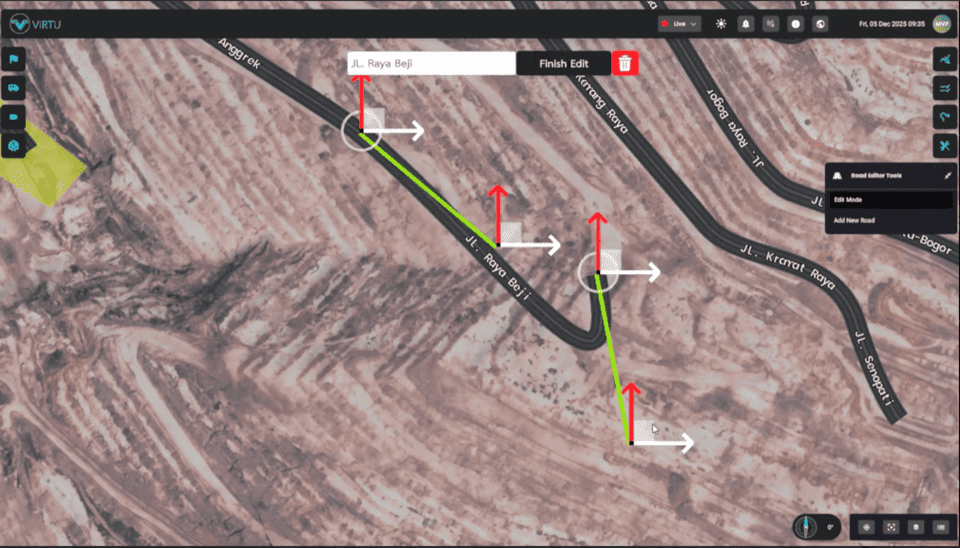
Featured digital twin work includes Smart Digital Twin Mining for coal mine operations, visualizing complex terrain, vehicle data, and analytical layers in interactive platforms. The same platform infrastructure supports Heavy Duty Mining Vehicles VR Training, working at height safety scenarios, and other industrial training applications relevant to mining work.
Virtu’s process for digital twin engagements follows four stages. Diagnose (understanding the operational requirement and matching twin type to actual gap). Design (architecting the twin scope and integration approach). Develop (building the twin and integrating with operational systems). Deploy (installation, testing, training for operational handover).
The company is Indonesian-based with engineering and project delivery capacity in-country. This matters for digital twin work that requires sustained collaboration with site operations, IT teams, and operational stakeholders. Voice prompts and UI default to Bahasa Indonesia with English available for multinational operations.
For digital twin scoping conversations, capability briefings, or pilot deployments, Virtu can be reached through the contact form at https://virtu.co.id/contact-us/ or via WhatsApp at +62 812 9696 7887.