
The four-minute window between cardiac arrest onset and the beginning of permanent brain injury is the foundation of bystander BLS protocols worldwide. Each minute without chest compressions reduces survival probability by approximately 10%. By the six-minute mark, survival odds decline sharply. Beyond ten minutes without intervention, survival outcomes are limited even when advanced medical care arrives afterward.
This time window has direct implications for workplace first aid programs. Ambulance response times in major Indonesian cities — Jakarta, Surabaya, Bekasi, Tangerang — typically exceed the four-minute window. In industrial estates such as Cilegon, Cikarang, and Karawang, response times often extend past 15 minutes once gate clearance and access road conditions are factored in. The operational implication is that the first effective response will come from personnel already on site, not from the emergency medical system.
Standard first aid training in Indonesia, delivered through PMI, BNSP-recognized providers, or Kemnaker-aligned programs, covers the necessary procedural content. The limitation is not the curriculum. It is the absence of practice conditions that resemble the physiological and cognitive environment of an actual emergency response.


How Acute Stress Affects Procedural Performance
Under acute stress, several measurable cognitive changes occur. Working memory capacity narrows. Attention focuses selectively, often on a single stimulus. Complex procedural sequences become harder to retrieve in full. What remains accessible is procedural memory that has been automated through repetition rather than learned through a single exposure.
This pattern is documented in research on military, emergency medical, and law enforcement performance under stress. The consistent finding is that performance during a crisis reflects the conditions under which the skills were practiced. Skills rehearsed under calm conditions tend to degrade under operational stress. Skills rehearsed under conditions resembling the operational environment retain more reliably.
Classroom manikin practice does not reproduce the physiological state of an actual emergency. Participants know the manikin is not a real victim, the scene is not active, and there is no consequence attached to a delayed or incorrect action. The stress response that accompanies real cardiac arrest events does not engage during the training.
What Changes in an Immersive Training Environment
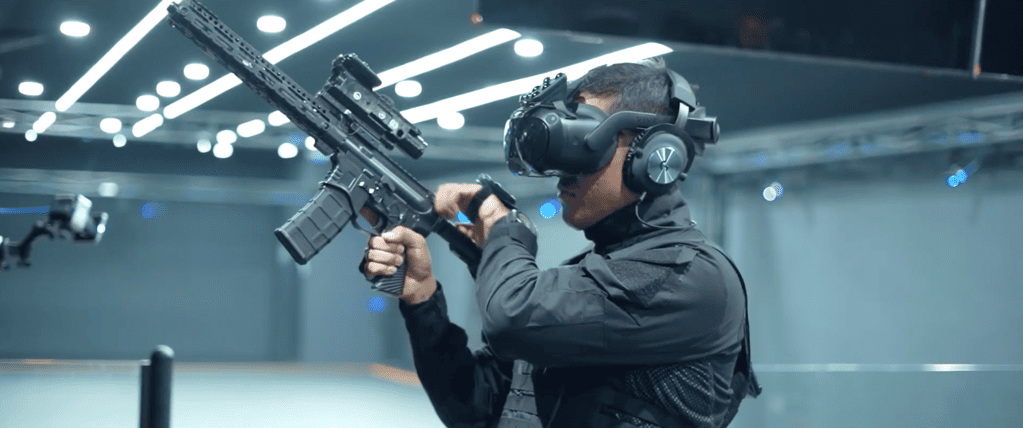
VR-based first aid training engages a partial stress response that classroom training does not produce. The headset displays a collapsed victim, ambient audio reflects the location, and a timer runs in real time. Trainees know the scene is simulated. The brain processes the visual and auditory input as partially real, which engages baseline physiological responses including elevated heart rate, narrowed attention, and time pressure on decision-making.
This is closer to the cognitive condition in which procedural skills need to be retrievable. Training under this condition produces skill retention that aligns more closely with operational performance than classroom-only training does.
The practical effect is the difference between recalling a procedure and executing it under pressure. Participants practice the full sequence — scene check, responsiveness assessment, calling for emergency services, compression initiation, AED retrieval — while also managing the hesitation, task delegation, and information processing that occur in a real response.
Scenarios That Are Difficult to Practice in Conventional Training
Cardiac arrest in a meeting room. This scenario combines BLS initiation with bystander management. The responder must delegate a specific person to call emergency services, another to retrieve the AED, and begin compressions within the first two minutes. Standard manikin training does not reproduce the social and communicative complexity of multiple untrained bystanders.
Choking in a cafeteria or break room. Choking response requires recognition of the choking sign, a decision between back blows and abdominal thrusts, and intervention before loss of consciousness. The victim is typically unable to speak and may move away from the scene before being assessed. These behavioral elements are difficult to reproduce with a static manikin.
Head injury with reduced consciousness. This scenario requires monitoring rather than immediate intervention. The responder needs to maintain a clear airway, monitor breathing, avoid unnecessary spinal movement, and prepare information for emergency medical personnel. The judgment component — when to act and when to hold position — is difficult to drill in conventional training formats.
Where VR Fits Within First Aid Certification
First aid certification in Indonesia requires hands-on practice with a qualified instructor. This applies whether certification is issued by PMI, Kemnaker, or an international body. VR does not satisfy this requirement and is not positioned as a replacement.
VR provides supplementary practice between certification cycles. The operational model used by organizations adopting this approach typically follows the same pattern: employees complete formal certification through the accredited pathway, then run periodic VR sessions to maintain skill retention during the interval between certifications. Research on resuscitation skill retention indicates that procedural skills, particularly compression depth and rate, begin to decay within three to six months without practice. Annual or biennial recertification is the regulatory baseline, but does not fully address this decay curve.
The model is most relevant for workplaces with elevated response time risk. Remote construction sites, offshore oil and gas platforms, mining operations, and industrial estates with extended ambulance access times share the same operational condition: the first effective response will come from on-site personnel, and the quality of that response is shaped by practice frequency rather than certification status alone.
Closing
Workplace first aid programs are usually evaluated against certification status. A more useful evaluation question is whether trained personnel would perform the correct sequence within the first four minutes of an actual cardiac arrest event. Certification alone does not produce this capability. Practice frequency is the relevant variable.
VR-based training is one method for increasing practice frequency at a manageable cost per session. It does not replace certification, hands-on manikin practice, or accredited instruction. It addresses the gap between certification cycles, which is the part of the training lifecycle where conventional methods are structurally limited by cost and scheduling.
VGLANT develops VR-based safety training for Indonesian workplaces, including first aid scenarios, fire response, APAR operation, hazardous material handling, and confined space training. The platform supports Bahasa Indonesia and English, runs on standard VR hardware, and aligns with AHA BLS guidance, PERKI references, and Permenaker P3K requirements.